Dec 23, 2017 | Intercom, Student News
September 30, 2015
Stephine Deeren doesn’t just go to work at Addiction Treatment Services. She fulfills her calling.
Her job as a detox care coordinator can be stressful, but Deeren, a 2013 NMC graduate, says that it’s worth it for the chance to help clients individually as well as to change community stigmas about substance abuse.
“It’s really rewarding in that you’re really making a difference,” she said.
What goes around, comes around. Back in high school, Deeren, now 26, was selected as an NMC Commitment Scholar. Since 1993, NMC has offered full-tuition Commitment Scholarships to promising first-generation college students who might not have the means to attend otherwise. The goal: to make a difference in their lives.
The class of 2019 will be inducted next week. Consisting of 113 students from schools throughout the Traverse Bay Area Intermediate School District, it’s the largest Commitment class ever.
It’s a pivotal moment for those students, said Deeren. Her career path began with an Introduction to Psychology class at NMC. She’s now pursuing her bachelor’s degree through Grand Valley State University at NMC’s University Center, and she eventually plans to get her master’s in social work.
“That’s where I found out what I wanted to do, was my first two years at NMC,” she said. “It really allowed me to have that self-discovery that I needed.”
Like Deeren, each student entering Commitment next week will have a chance for a full-tuition scholarship by meeting graduation and grade point requirements. For students outside Grand Traverse County, the value is up to $25,000. Commitment Scholarships are funded through the NMC Foundation and are a priority area for the college.
More than 1,000 students have gone through Commitment, with 91 percent completing the requirements.

Emily Sklodowske is another alumna.
“It was so significant. It was a huge turning point for me,” said the 2007 graduate of Benzie Central High School.
Sklodowske decided to try going away to school first. But after a year at Ferris, she returned to NMC where her Commitment scholarship was still available.
After a year here, Sklodowske was approved to use remaining scholarship funds on a study abroad trip to Italy. That hooked her on international travel and set the course for her career path.
“I knew, after Italy, that I had to go back. I had to keep doing that,” she said.
She now works at Passageways Travel in Traverse City and is planning a trip to Costa Rica in December. Her advice to incoming Commitment scholars? Do everything they can to maximize the opportunity.
“ I would go right straight to NMC after high school, if I could go back and change that,” she said, citing the “top-notch” faculty, classes and experiences she found on campus. “This is something you need to take advantage of.”
Dec 23, 2017 | Intercom, Student News
September 15, 2015
Record donation makes expansion possible
It was time for something big, Diana and Richard Milock decided.
NMC today announced the largest single gift by living donors in college history, a $2 million gift to expand the Dennos Museum Center. That gift also happens to be the largest ever for the Milocks, stalwart cultural philanthropists whose touch is evident everywhere in northwest Michigan, from Milliken Auditorium to the Bijou Theatre to the YMCA.
“We saw this as an opportunity to have a major impact on a community resource that we think is really important to the life of Traverse City. We’re really just so excited to be able to do this,” Diana Milock said.
The 9,000-square-foot expansion will house two new galleries intended to be named, respectively, the Gene Jenneman Permanent Collection Gallery and the Diana and Richard Milock Sculpture Gallery. The former honors the museum’s founding director. Under Jenneman’s quarter century of leadership the Dennos has built a strong permanent collection of works, but most sit in storage.
“We have wonderful works of art and there just isn’t room to show them,” Diana Milock said.
Art lovers and collectors themselves, the Milocks have supported both the Dennos and NMC’s Great Lakes Culinary Institute for more than a decade. Diana Milock has a special affinity for sculpture, which will be evident in the expansion. Windows lining one wall of the expansion will connect the new sculpture gallery to existing outdoor sculptures that surround the museum.
“I love outdoor sculpture. If we have access from the interior to observe the exterior, it’s a natural to fill that in,” she said.
The donation will also fund loading dock and storage improvements and a new classroom space.
“This gift from the Milocks speaks strongly to the support that Northwestern Michigan College has earned from this community and our shared desire to strengthen NMC’s role as a leader in providing cultural opportunities,” said NMC President Timothy J. Nelson.
“I am pleased to see this next step in the direction of the Dennos take place in our coming 25th year,” Jenneman said. “With these permanent collection galleries we will be positioned to make our art collection more accessible on an ongoing basis and to develop more defined connections to the College’s academic programs.”
Preliminary architectural drawings are complete. NMC hopes to bid the project in early 2016, the museum’s 25th anniversary year, and break ground later in the year.
Dec 23, 2017 | Intercom
March 11, 2015
Four years ago, single mom Kathy Tahtinen wouldn’t have put her name in the same sentence as Harvard University. Now, she’s considering online courses at the Ivy League school this fall.
Two years ago, Alan Holcombe was sitting in his cubicle in a Grand Rapids bank, second-guessing his choice of a finance degree. Next week he’s headed to an industry conference in Maryland, all expenses paid, to see just how far his engineering technology degree from NMC will take him.
Brian Sweeney’s educational resume includes degrees from West Point and Cornell. Now the Army retiree has come full circle to teach at NMC, where he took his first class as dual-enrolled student, building one of the college’s newest programs, photonics.
The trio have each received recent scholarships that collectively showcase not only the breadth of Northwestern Michigan College offerings, from transfer to technical, but the excellence across the board.
New Century Scholar
Tahtinen, 38, (pictured above, back row, second from right) has been named the New Century Scholar for Michigan, among just 57 outstanding community college students chosen from 1,700 nominated internationally. She’s a member of Phi Theta Kappa, the international community college honor society, and will graduate in May with three associate degrees. The scholarship will help the single mother of two high school students – one of whom shares her classes as a dual-enrolled high school student – continue pursuing a bachelor’s degree.
The Harvard extension opportunity would allow her to earn a degree while taking classes mostly online. Her NMC transcripts qualify her to take three pre-admission online classes, which would in turn determine whether she could apply for official admission.
“Having that confidence to even make the phone call to Harvard was definitely something new,” she said. “When you put a challenge in front of me, I’m going to find a way. It’s just my personality.”
Hydrographic Society scholars
Holcombe, 28, and fellow student John Lutchko both received scholarships from the Hydrographic Society of America. Engineering Technology didn’t exist at NMC when Holcombe graduated from Suttons Bay High School in 2005, and he went on to earn a bachelor’s in finance and economics from a four-year school.
Cubicle life didn’t agree with him, however, and Holcombe decided to look for something where he could use his hands. In NMC’s program, he uses them to build, program and operate robots that collect data underwater. Last summer he spent an internship with the National Park Service on Lake Superior. (At leftAbove, Holcombe operates a multi-beam sonar system on the lake.)
“It’s mind-blowing to me that this was in our back yard,” Holcomb said. “My office turned from a cubicle to going out on a boat and seeing things like bald eagles and even bear cubs on the beach every day.”
The employment odds have turned in his favor, and he expects to be able to field multiple job offers after he graduates this spring.
“I can’t wait to see where it takes me,” he said.
Optics and Photonics grant
Sweeney, meanwhile, will oversee a $15,000 grant from the National Center for Optics and Photonics Education (OP-TEC) for both scholarships and student recruitment. Photonics involves the use of lasers and other electro-optical devices in fields like manufacturing, medicine, aerospace, IT and defense. NMC was one of just four schools nationwide to receive the funding. Sweeney, 50, says the hands-on training provided is the reason why.
“West Point and Cornell had a lot of theory. We didn’t have a lot of grabbing the wrench and turning it,” Sweeney said.
Photonics started at NMC in 2012 and this is the second year the college has received the OP-TEC grant.
“These achievements illustrate the extraordinary breadth and depth of programming at NMC,” said Stephen Siciliano, NMC’s vice president for educational services. “From providing degree paths to having programs that are first in the nation and linked to our own bachelor degree shows both how broad our offerings are and the depth of scientific research that is often only associated with research universities. But one finds it here at NMC.”
Dec 23, 2017 | Intercom
December 30, 2014
How do you get girls interested in STEM (Science, Technology, Engineering and Math) fields?
Consider showing them some stems.
Real, live, green ones, that is, with leaves growing. Put the girls — young women, really — in charge, from planting the microgreens to tending them to monitoring them. Charge them with running experiments and collecting data, like whether the greens grow better under fluorescent lights or LED lights, and whether plain water or fish tank water is more nourishing. Let them harvest, and judge which kind tastes best.
That’s what intern Karla Vega and student Taylor West did this semester in a lab on NMC’s Great Lakes campus. The pair forged a research partnership that not only bridged language and cultural barriers but helps lay the groundwork for sustainable, indoor agriculture that could eventually improve the diets of millions.
“To get girls engaged in science we need to let them make decisions, give them room to make mistakes and try things out on their own,” said NMC Water Studies Institute Education and Outreach Coordinator Constanza Hazelwood, who supervised Vega and West’s research this semester.
NMC and EARTH University
Vega is a Bolivian student at EARTH University in Costa Rica, a leading institution in agricultural sciences and sustainable development. Hazelwood has cultivated connections at EARTH since 2009 and was looking to take the hydroponic vertical agriculture project she started a year ago to the next level. Enter Vega on a semester-long internship.
“Karla came with a lot of expertise in what we’re doing. She brought a lot of innovation to what we’re doing in the lab,” Hazelwood said.
The challenge of the vertical agriculture project bonded Vega, 20, who studies agronomy and natural resources management in Costa Rica, and West, 21, whose science interest was piqued in a high school agriscience program.
“People say, ‘why agriculture when you are from a city?’” said Vega, whose home city, Cochabamba, is home to almost 2 million people. “It was a challenge. This project can be used inside cities, where they don’t have space to grow crops.”
“That’s what women like, is a challenge,” said West.
The challenge will continue next semester, when West will visit Vega at EARTH, joining Hazelwood’s fifth study abroad trip to Costa Rica.
“The tables are going to be turned,” said West, who said her Spanish skills are negligible but expressed no concern about immersing herself in the language.
Hazelwood, too, has no doubts both students will continue to flourish. She notes that the pair made the greatest gains after the male student who originally supervised the vertical agriculture project left.
“They believe in themselves. They’re very self-confident,” she said. “It is about believing in them, at times it is getting out of their way, but always being available to support them.”
Dec 23, 2017 | Intercom
Collaborative Viticulture Students Reach Beyond the 45th Parallel
May 20, 2015
Kurtis Berry
Like a grapevine twining up a trellis, NMC’s collaborative viticulture program is growing tendrils of its own and is poised for a growth spurt this summer.
Two students in the five-year-old program are breaking new terroir with their summer internships. Kurtis Berry (right)(above) is the first to intern overseas, at Vignamato winery and vineyard in Marche, Italy, while Ethan Baker (below) is the first to head to the Pacific Northwest. He’ll spend his summer at Winemakers, LLC, a vineyard management company in Washington’s Yakima Valley.
Worldwide, the wine industry traces its history back hundreds of years, so those are impressive placements for students from a program that just began in 2010. Viticulture is the newest plant science certificate option offered by Michigan State University at NMC’s University Center. About 28 students are now enrolled, simultaneously pursing an associate’s degree from NMC and an MSU viticulture certificate.
Berry and Baker will complete their internships while on hiatus from their jobs in the regional wine industry, at Brys Estate and 45 North, respectively. The latter is named for the 45th parallel of latitude, which makes both northwest Michigan and Washington suited to grow wine grapes.
“I chose Washington because, parallel-wise, it’s very similar to Michigan,” Baker said. Yet the industry there operates on a completely different scale. Winemakers LLC manages about 1,200 acres of vineyards — equivalent to almost half the wine grape acreage in the entire state of Michigan.
Ethan Baker
“It’s not an experience I could get in this area,” Baker, 22, said.
That’s exactly the point, said viticulture program coordinator Brian Matchett.
“Our industry, the grape and wine industry in Michigan, is going to be stronger if you have experiences in another part of the country, or another part of the world,” Matchett said.
Berry, 25, is equally enthusiastic, even though he doesn’t speak much Italian.
“I’m thrilled. I think it’s going to open my eyes about old world viticulture,” he said. “It’s going to open my eyes to the industry as a whole.”
Both students will return to Traverse City in August. Baker plans to graduate from the viticulture program this December and Berry in May 2016.
Learn more about the NMC-MSU viticulture and other plant science programs »
Dec 23, 2017 | Intercom
March 24, 2015
A contingent of NMC students, faculty and staff who depart for Cuba Friday are the leading edge of a new distinction for the college: more study abroad students and destinations than any other Michigan community college.
The Cuba experience is among seven planned study abroad experiences this year. About 80 students from a dozen programs will travel to six different countries, including Cuba, South Africa (also during spring break), Brazil (two trips), Italy, Russia and Costa Rica. According to a survey by NMC’s International Services & Service Learning office, that’s more than any other community college in the state.
Jim Bensley directs that office and also teaches a World Cultures class. He chose Cuba as a destination before President Obama announced a plan to thaw relations with the Communist nation last December. With greater economic development imminent, experiences on the island isolated for half a century becomes even more valuable now.
“It’s rare U.S. residents ever get the chance to visit Cuba,” he said. “With Cuba so inextricably linked to the past, there is a genuine uniqueness that won’t always be as apparent as it is today.”
Looking forward to culture shock
Visual communications student Desiree Morgan is looking forward to that culture shock. She’s never traveled further than Canada, but had an interest in studying abroad. VisComm students are planning to film a documentary during the trip, which counts as academic credit.
Michael Meteer initially signed up by accident, selecting a course code that included the Cuba experience instead of one that did not. But the psychology student is happy with how things turned out.
“I’m most looking forward to the stories I’m going to come back with,” he said.
An increased emphasis on study abroad is part of the college’s strategic direction to ensure that NMC learners are prepared for success in a global society and economy. Next year, Bensley is planning eight student study abroad trips to several new destinations, including Guatemala, Ecuador, Greece and possibly Ethiopia.
For more information visit nmc.edu/study-abroad.
Dec 23, 2017 | Intercom, Student News
June 17, 2015
When the National Cherry Queen is crowned next month, Hannah Beaudry will be hoping the luck of the pine tree is on her side.
The NMC student is one of four finalists vying for the 2015 crown. If she wins, Beaudry, 19, will become the fifth queen within the past decade with NMC connections.
“Being able to have a college experience in beautiful Traverse City, Michigan, is such a blessing to me. Hopefully there’s a lucky charm with NMC and cherry queen, but who knows,” said Beaudry, a 2013 Elk Rapids High School graduate who is studying elementary education.
She’ll finish her NMC classes in December and then go on to complete her bachelor’s through Central Michigan University at the University Center.
The Cherry Queen scholarship would cover the remainder of her tuition costs, she said.
“It would be life-changing to earn that scholarship and graduate college debt-free,” she said.
At NMC, Beaudry’s favorite instructor has been history professor Jim Press.
“He made us think in such an amazing way. He really focused on critical thinking,” she said. “The way he lectures is like he’s telling a story, and it just made history so interesting. And I did not love history before that.”
On July 10, Beaudry will hope to make National Cherry Festival history, walking away with the crown first awarded in 1925.
Dec 23, 2017 | Intercom, Student News
December 6, 2017
Commuters hurrying home along Eighth Street these dark evenings will find a bright spot, thanks to a collaboration between NMC and Roost.
NMC’s solar power trailer is lighting up the Roost prefabricated tiny home located at 444 E. Eighth, opposite Family Video. The home is illuminated from 5–8 p.m. nightly.
The collaboration is designed to show what’s possible with solar energy, said NMC construction technology adjunct instructor Mike Schmerl.
“It does work, in northern Michigan, in the winter,” said Schmerl.
And it’s ideal for Roost, said Geoff Nelson, a co-founder of the company that created the 370-square-foot, finish-ready home that’s occupied the former vacant lot since June.
“There’s a great many people who want to live smaller, greener,” Nelson said. Roost’s other green features include renewable materials, a sustainable building process and tight building envelope to maximize energy efficiency.
Parked on the home’s west side with its solar panels tilted south, the trailer is only illuminating the home, not heating it or powering appliances. Still, it kick-starts consideration of solar, said Schmerl, whose own Traverse City home is 50 percent solar-powered.
“All things are possible,” Schmerl said. “What we demonstrate is expandability.”
NMC first developed the solar trailer in 2006. Schmerl updated it for the Roost project using equipment sold to the college at a discount.
“The technology has become more user-friendly, easier to understand, and more adaptable to people’s power requirements,” said Schmerl. “Using that trailer and our classroom skill set, we can adapt to almost any inquiries.”
As electric cars become more prevalent, Schmerl sees more opportunity for solar growth. The website Charge Hub lists 26 public charging stations in Traverse City, including at the Cambria Suites hotel, the original Meijer parking lot, and the Old Towne parking deck just down the street from Roost.
“Why wouldn’t they package the sale of an electric vehicle with the sale of the charging equipment, which would lead to the sale of the solar,” he said.
Nelson agreed that he’s seeing interest increase among all kinds of clients, from millennials to boomers.
“It’s been super encouraging to see the people responding to living smaller, greener, low-maintenance,” he said.
Dec 23, 2017 | Intercom, Student News
February 25, 2015
Back in 2012, as one of NMC’s pioneer students in Unmanned Aircraft Systems, Brad Kent found himself with a job offer before he’d even finished his training, and headed overseas for six-figure work as a civilian contractor. Now, as approvals for domestic use of UAS rise by the week, Kent and fellow former NMC students are poised to help guide the industry’s development into its second, commercial phase.
NMC was on the forefront of unmanned aircraft training, offering its first classes in the fall of 2010. Students like Kent (front row, second from right) and Darrell Trueblood (back row, far right) found getting in on the ground floor paid off, literally
“Before I even finished my degree I had placement in industry,” said Kent, 24, of Traverse City. He and Trueblood, 35, are among four NMC pilots now deployed in Afghanistan as civilian contractors with an Arizona-based manufacturer of UAS.
They provide force protection services to military, a job both see as worthy and important. Lengthy deployments and life on a military installation create a trade-off, however. “Balancing the benefits of income vs. the moments you miss with your friends and family becomes the tough part,” said Trueblood, who is married and a father to three. His wife and three children live in Tennessee.
“It puts a strain on relationships, it puts a strain on a social life,” said Kent, who still says it’s an “amazing experience” to work overseas.
UAS industry gets go-ahead to expand
Now, however, the strains and trade-offs are easing as the UAS industry gets the go-ahead to expand domestically.
Until 2014, the FAA strictly limited use of UAS vehicles in U.S. airspace. The first commercial exemption was granted in June 2014, allowing surveillance of oil fields in Alaska. Since December 2014, the FAA has approved more than 20 other exemptions for uses ranging from photography to agriculture.
Kent anticipates returning stateside later this year, to corporate headquarters in Tucson, Ariz. He’ll work on UAS research and development and train other pilots to fill the vast number of openings the industry expects as commercial permissions expand. “With pending FAA regulations for Unmanned Aerial Systems on the very near horizon, growth in this industry will be immense. Activities like movie production, agriculture monitoring, and infrastructure inspection will become an everyday occurrence, requiring trained professionals,” said Tony Sauerbrey, UAS program manager.
“This career field will grow exponentially in the coming years, both with pilots and support staff,” Trueblood agreed. His advice to prospective students is to be open to change.
“What you know today may be different from what you learn tomorrow. Be willing to continuously learn and continue your education,” he said.
It was that kind of attitude that led Kent to enroll in the first UAS classes.
“At the time it was a couple classes that you could add on if you were going through the manned aviation program,” Kent said. “NMC was very cool in the fact that they were willing to offer classes like that, new technologies.”
Sauerbrey said NMC will continue to grow with the industry and plans to offer full UAS pilot certification once the FAA finalizes regulations. NMC will also continue to work with leading UAS companies to provide a conduit for students seeking to enter the industry.
Dec 23, 2017 | Intercom
February 24, 2015
How do you transform a two-time college dropout into a Dean’s List student?
Give her a bridge and a foundation. Walk her over and shore it up.
In 1998 Lindsey Grice enrolled at NMC, fresh out of Traverse City Central High School and mother to a newborn daughter. It didn’t go well.
“I just failed miserably. It wasn’t something I knew about. I had a full course load and a little baby and it was too much,” Grice said.
She tried again a decade later. By 2008 she was a mother to three, including a son with intensive mental health needs. Grice had to take six credits and earn a 2.0 in order to keep her financial aid. Her attendance was spotty due to her son’s care giving demands, and she did well in one class but not the other. She lost her financial aid and dropped out a second time.
Fast-forward to 2014. A friend told Grice, now 34, about NMC’s Bridge program. Created for nontraditional students attending college for the first time or returning after past attempts, Bridge endeavors to lay a foundation for student success. Just last year, the program was redesigned so that what were formerly preparatory classes are now for-credit. Significantly, that makes Bridge students eligible for financial aid.
Coordinating Student Success
NMC Student Success Coordinator Ashley Darga walked Grice through the process of petitioning to reinstate her financial aid. Regulations have changed to favor students like Grice, Darga said.
“I was able to get my Pell grant to be able to take classes this fall,” Grice said. Her foundation steadied.
Almost simultaneously her son Brandon, now 15, entered a residential school, further firming her foundation.
“I’ve taken care of him completely. Now he’s receiving help out of the home (and) he’s doing really well,” Grice said. “I’m able to focus on my studies instead of spending every waking moment worrying about him.”
Finally, her daughter Ashley—the newborn during Grice’s first college stint—now 16 and a high school junior, threw down the gauntlet.
“She kind of challenged me,” Grice said. “My oldest daughter is getting ready to graduate, and she had mentioned to me that I should go back and get back my classes before she does.”
That challenge completed the foundation underpinning Grice’s turnaround. Bridge students take nine credits (five classes) their first semester. Grice earned a 4.0 and made the dean’s list.
“I think I was really determined this time,” she said, citing one class, Academic Study Methods, as a key.
“I’ve learned what things I can utilize through the school. I know there’s tutoring, I know there’s all that stuff, but actually using it I feel more confident.”
Transforming students to active participants
Instructor Shannon Owen said transforming students from passive to active participants in their education is another crucial piece of college success.
“They have to advocate for their own needs. We don’t know they’re struggling or that they don’t understand concepts,” Owen said.
Grice started out strong and only improved over the semester, turning in assignments early, Owen said.
“She’s got such motivation and heart. It’s great to see students succeed and watch that happen throughout the semester.”
Grice’s long-term aim is a business management degree. More immediately, she’s focused on next semester’s classes, especially English 111. It will be the fourth time she’s attempted the class. This time she’ll have a study partner: daughter Ashley, registered in the same course as a dual-enrolled student.
“It’s hard for me (but) I am ready for it,” Grice said.
Dec 23, 2017 | Intercom
June 3, 2015
At five years old, NMC’s Costa Rica study abroad program has many age-appropriate traits: it’s thriving, energetic, and ready to explore.
It’s also something most five-year-olds are not: The Central American nation from which a dozen NMC students returned this week is the most mature of NMC’s study abroad experiences.
Started in 2011 by Constanza Hazelwood of NMC’s Great Lakes Water Studies Institute, the heart of the experience is a partnership with EARTH University, an internationally renowned agronomy school near the Costa Rican port of Limón. This year, students in Freshwater Studies, Aviation and Plant Science all took part in the two-week sojourn on the tropical isthmus connecting North and South America.
The multi-disciplinary nature of the 2015 trip is one of the key signs of maturity. Another is reciprocity. Last fall, the GLWSI hosted EARTH researcher and faculty member Alex Pacheco as a guest lecturer. Pacheco then invited another colleague to propose a project for this year’s trip that combined the skills and experience of NMC students in both Watershed Science and Unmanned Aerial Systems: an examination of the spread of Sigatoka negra, a fungus that threatens banana production around the world.
“I have been to Costa Rica before, but this time I am not just a tourist, I am there to make a contribution. We are helping maintain a healthy watershed surrounding a banana plantation,” said Water Studies student Eoghan O’Connor.
To that end, students wielded both machetes and eBee, a professional mapping unmanned aerial system (UAS), on a banana plantation. Under Hazelwood’s guidance, they evaluated the effects of a buffer zone along the shorelines of the river running across the plantation.
“Our partnership with EARTH has grown into a solid network of professionals working together to solve relevant environmental problems impacting the globe’s water resources,” Hazelwood said.
They also practiced their Spanish in a home stay experience and soaked up as much culture and local lifestyle as possible.
“Beautifully overwhelming”
“This whole experience has been beyond incredible. All of us students have described it as sensory overload. Touch, smell, sight, taste has all been so beautifully overwhelming,” Water Studies student Taylor West wrote on her blog.
Now back home, trip participants are preparing to debrief and discuss how their internship in Costa Rica can serve as a template as NMC’s Office of International Services and Service Learning seeks to offer more study abroad experiences in service of the college’s strategic goal to ensure that NMC learners are prepared for success in a global society and economy.
“Successful foundations like those with EARTH University allow us to think creatively when building future opportunities for multi-disciplinary study abroad,” said director Jim Bensley.
Dec 23, 2017 | Intercom
April 8, 2015
Every industry offers pinnacles. Entertainers aspire to Oscars and Grammys, doctors and diplomats to Nobels, and chefs to Michelin stars.
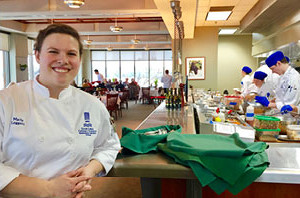
Great Lakes Culinary Institute graduate Leslie Farrer has barely begun her career and has already helped collect one of those coveted stars. The Traverse City native, 27, is a pastry sous chef at Trump Hotel in Chicago. One of its restaurants, Sixteen, just earned its second Michelin star.
“It’s excellent. You don’t get that just by being good,” said one her NMC mentors, Chef Mike Skarupinski. “That’s something to be very, very proud of. It’s a great reward.”
Farrer discovered her interest in pastry while working at a restaurant as a student at Traverse City West High School, and toured Chicago’s renown French Pastry School. But she didn’t want to move at age 18. Enter the Great Lakes Culinary Institute.
She found the culinary curriculum, from knife skills to purchasing to menu planning, second to none. She also took her first pastry classes with Skarupinski, who remembers her as an excellent student. In contrast to savory cooking, pastry is technical.
“Pastry attracts more people who are good at math. Our recipes are very specific, they have to be very precise to get the result you want,” Farrer said.
After graduating in 2008, it was on to Chicago where she first attended and then interned at the French Pastry School. Next, she moved to Vanille, a small patisserie owned by an instructor, where she worked for four years, the last two as executive pastry chef.
She took an entry-level pastry chef position at Trump in 2013 and has already been promoted to one of two pastry sous chefs. The position offers a variety she enjoys. She might spend her work day baking bricks for a holiday gingerbread house, dipping strawberries for Sunday brunch, or planning the dessert menu for Sixteen, now one of only three restaurants in Chicago to boast two Michelin stars.
Farrer’s married to her high school sweetheart, Brian Farrer, who also attended NMC for a year and a half before transferring to DePaul University. He’s a mergers and acquisitions consultant in Chicago.
While the couple is comfortably settled in the Windy City now, Farrer remembers NMC fondly.
“It gave me a couple years to grow up,” she said. “I learned a lot about myself and how I handle situations and stress and work with other people in stressful situations.”
Skarupinski said Farrer’s success should inspire future culinary students, too.
“Having her start at NMC is another very good accomplishment for our future students as well,” he said.
Dec 23, 2017 | Intercom, Student News
November 8, 2017
Since 2012, NMC has prioritized the success of student veterans on campus with a host of initiatives led by the office of Military and Veterans Services — from customized orientation to a veterans lounge to efforts to convert service into credits.
Tonight, some NMC veterans will take a step toward connecting the broader community with the experience of contemporary military service by taking part in a panel discussion following the 7 p.m. free screening of Almost Sunrise at Milliken Auditorium. The documentary tells the story of two veterans who embark on a cross-country hike in an effort to heal the psychological wounds left by their military service.
Construction technology student Fernando Cruz is familiar with that restless urge. An Army reservist between 1997 and 2010 who was deployed to Iraq for a year, he too crisscrossed the U.S. for work after his discharge.
“It’s not coincidental,” said Cruz, now of Kingsley, of his nomadic work transporting vehicles, and later for a drill rig company. “I was getting away. I had to get away.”
The father of twin 18-month-old sons, Cruz, 37, thinks there’s a “big disconnect” between civilians and military members. Tonight, he’ll try to help make that connection.
Veterans Day commemoration
Presented by NMC’s chapter of Student Veterans of America and 22 to None, an organization dedicated to stopping veteran suicide, the film comes as NMC prepares to commemorate Veterans Day on campus. The following events are scheduled for Monday, Nov. 13:
- 8:30 a.m. – Free breakfast for all veterans and active duty military in the Hawk Owl Cafe in West Hall.
- 9:20 a.m. – Walk of Honor. The campus community is invited to line up along the sidewalks from West Hall to the flagpoles west of the Tanis Building. Led by the Traverse City Central High School drum line, veterans will walk from West Hall to the flagpoles.
- 9:30 a.m. – Flag-raising ceremony conducted by the VFW with the Traverse City Central High School band.
- 10 a.m.–noon – Coffee and cake served in West Hall for the entire campus community in honor of veterans.
About five percent of NMC students are veterans. For the third consecutive year NMC has been certified as a Gold-Level Veteran-Friendly School by the Michigan Veterans Affairs Agency. NMC was also named the fifth-best “Best for Vets” community college nationwide by Military Times in 2016.
NMC will also focus on the student veteran transition in the January 2018 issue of Nexus, which will be published as the nation marks the ten-year anniversary of the post-9/11 GI Bill, which granted educational benefits to veterans serving after Sept. 11, 2001.
Dec 23, 2017 | Intercom, Student News
October 11, 2017
NMC welding students Andrew DuBois and Michael StolarczykSome NMC welding students are getting a dose of American history on top of this semester’s classes.
They’re helping to restore Civil War markers placed on the graves of Union Army veterans in northern Michigan cemeteries. Thanks to an instructor’s idea, the extracurricular project is increasing their skills and their citizenship, one cast iron star at a time.
Adjunct electrical instructor Jeff Morse is a member of the Sons of Union Veterans of the Civil War, a national group that works to honor the memory of the soldiers killed between 1861-65. A feature of the Union graves the group charges itself with maintaining is a cast iron star flagholder, inserted into the ground with double spikes.
A Civil War marker repaired by NMC welding students“Over the years they became no match to power lawn mowers and brutal northern Michigan winters. Many markers became rusty and either one or both of the spikes had been broken off,” Morse said.
He mentioned it to welding instructor Devan DePauw, who agreed to take on repair as an extracurricular project with student volunteers. Students cut off the double legs, grind and prepare the stars for welding, and then weld one spike in a new, center position.
It’s an opportunity to learn new techniques from the typical steel-to-steel welding they do in class.
“Cast iron is notoriously difficult to weld,” DePauw said. Students are learning a “brazing” technique that uses a bronze filler to weld the spike back on.
It’s also an opportunity to apply their knowledge for a greater good.
“I like doing stuff that matters. This epitomizes that,” said Michael Stolarczyk, 18, of Traverse City.
“I just think it’s a good cause,” said Andrew DuBois, 28, of Flint.
Group member Scott Schwander, who has been cleaning the headstones as well, returns the repaired star flagholders to the graves. He started with Oakwood Cemetery near main campus, where about 300 Union veterans are buried. The Robert Finch Camp of which both Schwander and Morse are members serves 16 northern Michigan counties and estimates that more than 1,000 Union veterans are buried in the five-county Grand Traverse region.
Camp commander Ted Matti, sees the project as a win–win.
“Being they’re in a welding program, they have to work with various kinds of metal,” he said. “Any time you can get involved with anything in the community of historic significance, or helping others, that’s all part of being a citizen in the community, and that’s a good lesson, too.”
Dec 23, 2017 | Intercom
April 22, 2015
At just 21 years old, Traverse City native Nick Alpers has checked off a lot of life’s milestones already. He’s earned his bachelor’s degree, married, and is working full-time in his chosen field of mechanical engineering.
The 2012 NMC graduate is unique in another way, too: Alpers, who graduated summa cum laude from Saginaw Valley State University last year, has zero student loan debt.
Zero as in zip. Zilch. None. As in, a stark contrast to his peers. Statewide, 63 percent of Michigan’s 2013 bachelor’s graduates took on student debt, according to the Project on Student Debt. On average, each owes more than $29,000.
What’s the difference? Simply put, motivation and NMC dual enrollment.
Dual enrolled in 2010
Alpers dual-enrolled in NMC as a senior at Traverse City Central, back in 2010. He took 28 credits that year, more than half of what he needed for his engineering certificate, all paid for by his high school. He attended NMC for another year and worked in the math lab before transferring to SVSU in 2012. There he completed the last two years of his bachelor’s in a year and a half. Now, his paycheck from Nexteer Automotive, a Saginaw manufacturer of steering columns and gears, belongs to just him and his wife Kaitlyn (Green) Alpers, a pre-physician’s assistant student at SVSU.
“I know that some people are in their 30s and still paying off debts. Now I can allocate that money to something else,” said Alpers.
Financial and academic advantages
Besides the financial advantage, Alpers speaks highly of NMC’s academic rigor, noting that his GPA at Saginaw Valley was higher than at NMC.
“It was definitely worth it. It helps you to prepare,” said Alpers, whose two older brothers also attended NMC. “I came down here and I thought (SVSU) was a breeze.”
Not too far down the road, the “something else” might be getting home. Kaitlyn, who also dual-enrolled at NMC for her senior year in 2011-12, has her eye on a master’s PA program that Grand Valley recently started at NMC’s University Center.
Dec 23, 2017 | Intercom, Student News
November 22, 2017
In this season of gratitude, quality child care is near the top of the list for the young families fortunate enough to have found it.
This fall, one NMC alumna took a step toward filling that crucial community need by doubling her home child care capacity, including more desperately-needed infant care. Alison Burns’ Healthy Start Child Care in Traverse City also now employs two NMC child development students, (including Emily Spica, above) providing them valuable work experience.
A licensed provider in Michigan since 1996, Burns (right) originally chose child care as a way to stay home with her own three children. Until this year, her license limited her to six children in care simultaneously, only two of whom could be under a year old. However, Burns self-limited infant enrollment to one. She frequently had a waiting list, and felt badly for the families she had to turn away.
“There’s such a demand for infant care,” she said.
Then this fall, timing and preparation coincided, allowing Burns to help meet that demand.
Back in 2011, inspired to learn more about children with special needs after one came into her care, Burns enrolled in an Exceptional Child psychology class at NMC. Child development program coordinator and instructor Cheryl Bloomquist then persuaded her to complete the entire Child Development certificate course sequence — 32 credit hours. Even after practicing child care for 15 years, Burns found herself invigorated in the classroom.
“It reinforced what I already knew, (and) I learned so much,” she said. An Infant and Toddler Development class was especially beneficial, she said, bolstering her knowledge of best practices for that age group and confidence working with them.
She completed her certificate in 2013 and returned to running her six-child daycare home. She also made time to serve on Bloomquist’s Early Childhood Advisory Committee.
“Her input is so valuable, because I don’t always have a family home provider there,” Bloomquist said.
Fast-forward to this fall, when Burns’ youngest daughter left for college, creating more physical space for child care in their home. Simultaneously Burns was up for relicensing, and the lack of child care regionally had become an acknowledged obstacle to continued economic growth.
“Babies need care, and they need good care,” said Bloomquist. “They take up a lot of space and they take up a lot of employees.”
Burns decided to expand her license to allow her to care for 12 children, up to four of whom can be younger than 18 months. All those slots are filled, and in fact she cares for 19 different children over the course of a week, since some attend part-time.
She also turned to NMC to find staff. Both Kalee Lown, lead infant and toddler teacher, and Spica, lead preschool teacher, are NMC students. On a recent brisk morning, Spica played with preschoolers in Burns’ backyard while Lown and Burns each held an infant, and another napped.
“I get to apply the things we’re learning in class,” said Spica, who will graduate next spring. “A lot of (the work) coincides with the assignments we’re given.”
Burns empowers them to use their education on the job.
“These teachers are teachers. They’re not just waiting for me to tell them what to do,” she said.
“Now she is the mentor,” Bloomquist said. “It’s just been a really good fit.”
For information on Healthy Start Child Care, call (231) 933-7002.
Dec 23, 2017 | Intercom
August 19, 2015
School and Scouts.
Back in fifth grade, Stephen Siciliano found two things he liked and decided to stick with them.
Since then, he’s climbed to the pinnacle of both worlds. He’s vice president of educational services at NMC, and not only an Eagle Scout himself but a father of three more — all of whom also attended NMC.
Yet as he embarks on his fourth decade on campus, Siciliano, who wears a Scout uniform in his campus profile picture, shows no sign of boredom or restlessness. He’s excited to continue work on the challenges the college faces, like developmental education, learning outcomes and internal communication. Viewed through the lens of history, his chosen academic field, he is confident those challenges will be met. (More on those in a moment.)
Siciliano’s own history is colored by a community college — Nassau Community College on Long Island, NY, where he grew up. A first-generation college student, he had an “absolutely wonderful experience” and chose to pursue his master’s and PhD degrees in the hope of teaching at the community college level himself. So when Walt Beardslee, one of NMC’s founding faculty members, came to recruit at a National History Conference which Siciliano also happened to attend, he found an eager candidate.
“I’m thinking, ‘You don’t have to sell me. I’d love to teach at a community college,’” Siciliano, 59, recalled of that interview.
He spent 11 years teaching at NMC, including six as director of the Humanities division, his first taste of administration. In 1996 he moved into his current role as the college’s top academic officer. One of the best changes he’s seen during that time is NMC’s shift from once-a-decade accreditation to a continuous academic quality improvement process, known as AQIP.
“They focus our attention,” he said of the AQIP action projects, including, not coincidentally, those three challenges of developmental education, learning outcomes and communication.
“People say, ‘we want to get this done,’” he said, citing developmental education, the project closest to completion. “I come away from that meeting so energized.”
And that history is why he thinks that the more recently tackled projects like learning outcomes and communications, will indeed be solved.
Siciliano’s parallel world of Scouting has been transformed by quality improvement, too. While he no longer leads an active troop, like he did for a dozen years with just-retired engineering instructor Jim Coughlin, Siciliano is still involved as a liaison between two local units and the broader Boy Scout organization.
“They’ve clearly moved to quality metrics, just like our college. How can we improve the experience for the boys?” Siciliano said.
Even after 30 years as an educator, that question still animates Siciliano, who plans to keep pursuing the answer for a little while yet.
“I hope I’m here,” he says of his plans for five years down the road.
Dec 23, 2017 | Intercom, Student News
October 28, 2015
NMC students pocketed an extra $137,000 this semester thanks to instructors using free and low-cost textbooks.
Led by Osterlin Library director Tina Ulrich, NMC is piloting an experiment in Open Educational Resources this semester. Ten instructors were selected to receive a stipend of either $500 or an iPad — provided by an NMC Foundation innovation grant — as an incentive to redesign their courses using free textbooks and other resources, often found online.
In the process, Ulrich discovered other instructors already using OERs or low-cost textbooks. In total, NMC has 17 instructors she calls “textbook heroes” teaching 880 students in subjects ranging from math to English to history to social work.
The hero label is no exaggeration for students in Brian Sweeney’s physics class, who each saved $198 thanks to his choice of an OER.

“I wouldn’t have bought it,” physics student Eli Seal, 31, said of the $198 textbook.
Pre-med student Alyson Bunker of Gaylord calls textbook prices “ridiculous.” One online book cost her $110, she said.
“It’s extortion,” said student Tripp Coleman, 25, of Traverse City. He’s attending school on the GI bill and has a book allowance of only $509 per semester. That’s barely two-thirds of the $750 NMC recommends students budget, which amounts to 15 percent of tuition costs, Ulrich said.
Students said prices for online books and book rentals are still inflated and rigged with late fees, and end-of-semester book buy backs don’t offer enough return. Many said they like the online nature of OERs like the one Sweeney chose, which can easily be searched for specific content and linked to supplementary material.
“My course is organized better than ever and the students like the extra videos and interactive supplements for the class,” said math instructor Deb Menchaca.
Students who prefer printed materials can download and print OER materials, Ulrich noted.
Besides the cost savings, instructors said going off-book allowed them to reinvigorate their courses with newer material.
“Our computers are outdated as soon as we buy them. Our textbooks are, too,” said social work instructor Lisa Blackford. Now she’s consciously choosing materials as varied as TED talks and podcasts and believes students are more engaged.
Sociology instructor Brandon Everest agreed. He uses a $30 textbook published through OpenStax College, a nonprofit initiative of Rice University. The book’s content is not as thorough as the one he previously used, but that creates an opportunity to customize the course.
“It is more skeletal, so we were allowed to hang the flesh wherever we saw fit,” he said.
In terms of student performance, most instructors said students did as well or better on tests as they did with traditional textbooks. Sweeney said every test and lab score is better this fall.
The pilot project also aligns NMC with national trends. Earlier this month two U.S. senators introduced the Affordable College Textbook Act, which would expand the use of OERs.