
To find these selections and many other new titles, see the NMC library catalog.
New Non-Fiction
 The Exvangelicals by Sarah McCammon
Growing up in a deeply evangelical family in the Midwest in the ’80s and ’90s, Sarah McCammon was strictly taught to fear God, obey him, and not question the faith. Persistently worried that her gay grandfather would go to hell unless she could reach him, or that her Muslim friend would need to be converted, and that she, too, would go to hell if she did not believe fervently enough, McCammon was a rule-follower and–most of the time–a true believer. But through it all, she was increasingly plagued by fears and deep questions as the belief system she’d been carefully taught clashed with her expanding understanding of the outside world. After spending her early adult life striving to make sense of an unraveling worldview, by her 30s, she found herself face-to-face with it once again as she covered the Trump campaign for NPR, where she witnessed first-hand the power and influence that evangelical Christian beliefs held on the political right. Sarah also came to discover that she was not alone: she is among a rising generation of the children of evangelicalism who are growing up and fleeing the fold, who are thinking for themselves and deconstructing what feel like the “alternative facts” of their childhood.
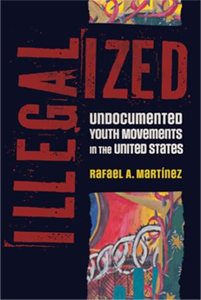 Illegalized by Rafael A. Martínez
This book takes readers on a journey through the history of the rise of undocumented youth social movements in the United States in the twenty-first century. It follows the documentation trail of undocumented youth activists spanning over two decades of organizing. Each chapter carefully analyzes key organizing strategies used by undocumented youth to produce direct forms of activism that expose and critique repressive forms of state control and violence. This inquiry is particularly generative in relation to how immigrant bodies are erased, contained, and imagined as “aliens” or “illegal.” Rafael A. Martínez, an undocu-scholar, intricately weaves his lived experience into this deeply insightful exploration. He shows that undocumented youth and their activism represent a disruption to the social imaginary of the U.S. nation-state and its figurative and physical borders.
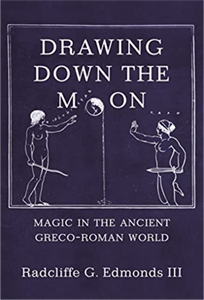 Drawing Down the Moon by Radcliffe G. Edmonds, III
What did magic mean to the people of ancient Greece and Rome? In this book, Radcliffe Edmonds, one of the foremost experts on magic, religion, and the occult in the ancient world, provides the most comprehensive account of the varieties of phenomena labeled as magic in classical antiquity. Exploring why certain practices, images, and ideas were labeled as “magic” and set apart from “normal” kinds of practices, Edmonds gives insight into the shifting ideas of religion and the divine in the ancient past and in the later Western tradition. Using fresh approaches to the history of religions and the social contexts in which magic was exercised, Edmonds delves into the archaeological record and classical literary traditions to examine images of witches, ghosts, and demons as well as the fantastic powers of metamorphosis, erotic attraction, and reversals of nature, such as the famous trick of drawing down the moon. From prayer and divination to astrology and alchemy, Edmonds journeys through all manner of ancient magical rituals and paraphernalia — ancient tablets, spell books, bindings and curses, love charms and healing potions, and amulets and talismans.
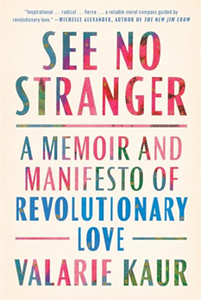 See No Stranger by Valarie Kaur
We have entered a new era in America–dangerous, divided, and uncertain. In a moment when people are hungry for meaningful ways to respond to the ascent of nationalism, polarization and hate in the U.S. and around the globe, this book answers the central question of our time: How do we love in a time of anger? Valarie Kaur is a renowned Sikh activist and in this book, she argues that Revolutionary Love is the call of our times. When we practice love in the face of fear or rage, it has the ability to transform an encounter, a relationship, a community, a culture, even a country. Drawing from her personal experiences, Sikh wisdom, and the work of civil rights leaders of all kinds, Kaur has reenvisioned love as a public ethic: a commitment to loving others, opponents, and ourselves.
 Andrea Zittel by Richard Julin
Blurring the line between art and life, Andrea Zittel’s fascinating experiments in functional living showcase her preoccupation with self-sufficiency and adaptability. An American artist, Andrea Zittel is best known as a builder of “living systems.” From furniture to trailers to a man-made island, Zittel’s structures are created as investigations into what humans need to survive. This exhibition catalog features numerous images from Zittel’s project in the desert near Joshua Tree, California, known as “A-Z West.” For nearly a decade she has been creating minimal self-sufficient dwelling spaces in which everyday actions such as sleeping, eating, cooking, bathing and socializing are transformed into acts of art. This volume documents the results of these experiments years after their inception.
New Fiction
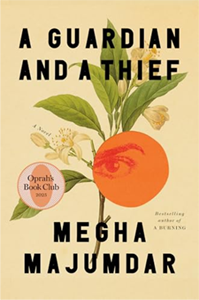 A Guardian and a Thief by Megha Majumdar
In a near-future Kolkata beset by flooding and blight, Ma, her two year old daughter Mishti, and her elderly father Dadu are just days from leaving the collapsing city behind to join Ma’s husband in the home he has been building for them in Ann Arbor, Michigan. After procuring long-awaited passports and visas from the consulate, they pack their bags for the flight to America. But in the morning they awaken to discover that Ma’s purse, with all the treasured documents within it, has been stolen.This novel tells two stories: the story of Ma and her family, their struggle to emigrate to America, and their devastation in the wake of the theft that changes their fate to one of implacable tragedy; and Boomba, the thief, whose hunger and desperation to care for his family drive him to commit a crime whose consequences he cannot fathom.
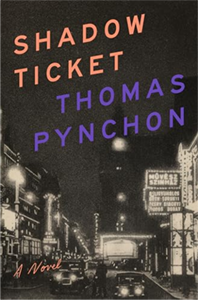 Shadow Ticket by Thomas Pynchon
Milwaukee 1932, the Great Depression going full blast, repeal of Prohibition just around the corner, Al Capone in the federal pen, the private investigation business shifting from labor-management relations to the more domestic kind. Hicks McTaggart, a onetime strikebreaker turned private eye, thinks he’s found job security until he gets sent out on what should be a routine case, locating and bringing back the heiress of a Wisconsin cheese fortune who’s taken a mind to go wandering. Before he knows it, he’s been shanghaied onto a transoceanic liner, ending up eventually in Hungary where there’s no shoreline, a language from some other planet, and enough pastry to see any cop well into retirement—and of course no sign of the runaway heiress he’s supposed to be chasing.
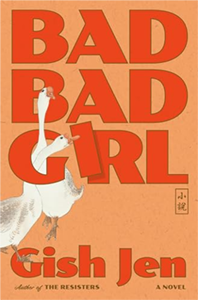 Bad Bad Girl by Gish Jen
Gish’s mother–Loo Shu-hsin–is born in 1925 to a wealthy Shanghai family where girls are expected to behave and be quiet. Every act of disobedience prompts the same reprimand: “Bad bad girl! You don’t know how to talk!” She gets sent to Catholic school, where she is baptized, re-named for St. Agnes, and, unusual for a girl, given an internationally-minded education. Still, her father would say, “Too bad. If you were a boy, you could accomplish a lot.” Aggie finds solace in books, reading every night with a flashlight and an English-Chinese dictionary, before announcing her intention to pursue a Ph.D in America. It is 1947, and with the forces of Communist revolution on the horizon, she leaves–never to return.
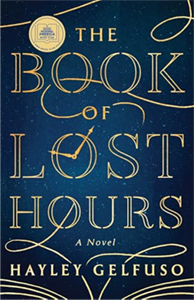 The Book of Lost Hours by Hayley Gelfuso
Enter the time space, a soaring library filled with books containing the memories of those who have passed and accessed only by specially made watches once passed from father to son—but mostly now in government hands. This is where eleven-year-old Lisavet Levy finds herself trapped in 1938, waiting for her watchmaker father to return for her. When he doesn’t, she grows up among the books and specters, able to see the world only by sifting through the memories of those who came before her. As she realizes that government agents are entering the time space to destroy books and maintain their preferred version of history, she sets about saving these scraps in her own volume of memories. Until the appearance of an American spy named Ernest Duquesne in 1949 offers her a glimpse of the world she left behind, setting her on a course to change history and possibly the time space itself.
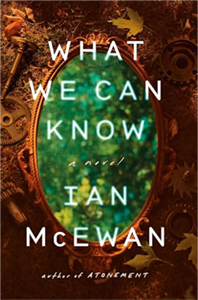 What We Can Know by Ian McEwan
2014: At a dinner for close friends and colleagues, renowned poet Francis Blundy honors his wife’s birthday by reading aloud a new poem dedicated to her, ‘A Corona for Vivien’. Much wine is drunk as the guests listen, and a delicious meal is consumed. Little does anyone gathered around the candlelit table know that for generations to come, people will speculate about the message of this poem, a copy of which has never been found, and which remains an enduring mystery. 2119: Just over one hundred years in the future, much of the western world has been submerged by rising seas following a catastrophic nuclear accident. Those who survive are haunted by the richness of the world that has been lost. In the water-logged south of what used to be England, Thomas Metcalfe, a lonely scholar and researcher, longs for the early twenty-first century as he chases the ghost of one poem, ‘A Corona for Vivian’.
Summaries and images adapted from publishers.