
To find these selections and many other new titles, see the NMC library catalog.
New Non-Fiction
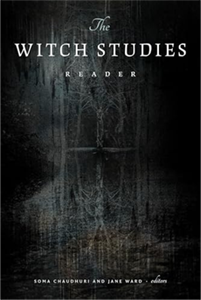 The Witch Studies Reader edited by Soma Chaudhuri and Jane Ward
The past decade has seen a resurgence of the esoteric and the occult into the Western mainstream, often as a queer feminist way to claim the power of the irrational and the “natural” world, and as a way of integrating critiques of colonial rationality into everyday practices. At the same time, poor, indigenous, and/or aging women across the global South are persecuted and even murdered for their real and imagined associations with practices that also fall under the umbrella of witchcraft. This book attempts to hold both of these truths together, offering a transnational feminist perspective on the power and the persecution of the witch, taking into account the vastly different national, political, economic, and cultural contexts in which she is being claimed and repudiated. Essay topics range from matrilinear knowledge sharing in Appalachia and witchy women in 1960s rock counter-culture to witch killings in Tanzania and the “decolonial love” of Romani witchcraft practices closed to outsiders.
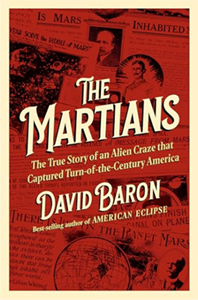 The Martians by David Baron
In the early 1900s, many Americans actually believed we had discovered intelligent life on Mars, as best-selling science writer David Baron chronicles in this truly bizarre tale of a nation swept up in Mars mania. At the center of Baron’s historical drama is Percival Lowell, the Boston Brahmin and Harvard scion, who observed ‘canals’ etched into the surface of Mars. Lowell devised a grand theory that the red planet was home to a utopian society that had built gargantuan ditches to funnel precious meltwater from the polar icecaps to desert farms and oasis cities. The public fell in love with the ambitious amateur astronomer who shared his findings in speeches and wildly popular books. While at first people treated the Martians whimsically–Martians headlining Broadway shows, biologists speculating whether they were winged or gilled–the discussion quickly became serious. Today, the red planet maintains its grip on the public’s imagination. Many see Mars as civilization’s destiny–the first step toward our becoming an interplanetary species–but, as David Baron demonstrates, this tendency to project our hopes onto the world next door is hardly new.
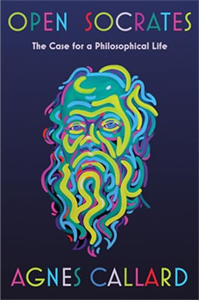 Open Socrates by Agnes Callard
Socrates has been hiding in plain sight. We call him the father of Western philosophy, but what exactly are his philosophical views? He is famous for his humility, but readers often find him arrogant and condescending. We parrot his claim that “the unexamined life is not worth living,” yet take no steps to live examined ones. We know that he was tried, convicted, and executed for “corrupting the youth,” but freely assign Socratic dialogues to today’s youths, to introduce them to philosophy. We’ve lost sight of what made him so dangerous. In this book, acclaimed philosopher Agnes Callard recovers the radical move at the center of Socrates’ thought, and shows why it is still the way to a good life. Callard draws our attention to Socrates’ startling discovery that we don’t know how to ask ourselves the most important questions–about how we should live, and how we might change.
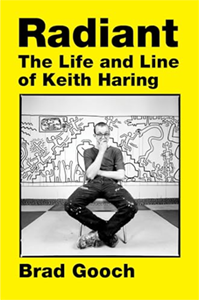 Radiant by Brad Gooch
In the 1980s, the subways of New York City were covered with art. In the stations, black matte sheets were pasted over outdated ads, and unsigned chalk drawings often popped up on these blank spaces. These temporary chalk drawings numbered in the thousands and became synonymous with a city as diverse as it was at war with itself, ravaged by poverty and oppression but alive with art and creative energy. And every single one of these drawings was done by Keith Haring. Keith Haring was one of the most emblematic artists of the 1980s, a figure described by his contemporaries as “a prophet in his life, his person, and his work.” Part of an iconic cultural crowd that included Andy Warhol, Madonna, and Basquiat, Haring broke down the barriers between high art and popular culture, creating work that was accessible for all and using it as a means to provoke and inspire radical social change.
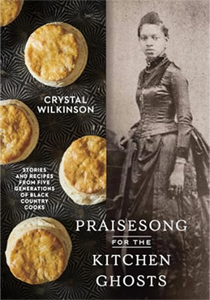 Praisesong for the Kitchen Ghosts by Crystal Wilkinson
A lyrical culinary journey that explores the hidden stories of Black Appalachians through powerful essays and forty comforting recipes from the Poet Laureate of Kentucky. Years ago, when O. Henry Prize-winning writer Crystal Wilkinson was baking a jam cake, she felt her late grandmother’s presence. She soon realized that she was not the only cook in her kitchen. There were an abundance of ancestors stirring, measuring, and braising with her. These are her kitchen ghosts, five generations of Black women who arrived in her region of Appalachia and made a life, a legacy, and a cuisine. Part food memoir, part cookbook, this work weaves fiction with historical records, memories, and interviews to present a unique culinary portrait of Black Appalachians.
New Fiction
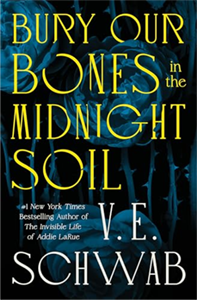 Bury Our Bones in the Midnight Soil by V.E. Schwab
This is a story about hunger. 1532. Santo Domingo de la Calzada. A young girl grows up wild and wily―her beauty is only outmatched by her dreams of escape. But María knows she can only ever be a prize, or a pawn, in the games played by men.This is a story about love. 1827. London. A young woman lives an idyllic but cloistered life on her family’s estate, until a moment of forbidden intimacy sees her shipped off to London. This is a story about rage. 2019. Boston. College was supposed to be her chance to be someone new. That’s why Alice moved halfway across the world, leaving her old life behind. But after an out-of-character one-night stand leaves her questioning her past, her present, and her future, Alice throws herself into the hunt for answers . . . and revenge. This is a story about life―how it ends, and how it starts.
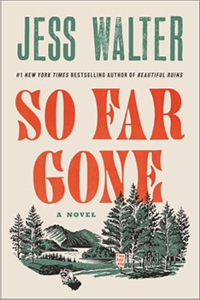 So Far Gone by Jess Walter
Rhys Kinnick has gone off the grid. At Thanksgiving a few years back, a fed-up Rhys punched his conspiracy-theorist son-in-law in the mouth, chucked his smartphone out a car window and fled for a cabin in the woods, with no one around except a pack of hungry raccoons. Now Kinnick’s old life is about to land right back on his crumbling doorstep. Can this failed husband and father, a man with no internet and a car that barely runs, reemerge into a broken world to track down his missing daughter and save his sweet, precocious grandchildren from the members of a dangerous militia? With the help of his caustic ex-girlfriend, a bipolar retired detective, and his only friend (who happens to be furious with him), Kinnick heads off on a wild journey through cultural lunacy and the rubble of a life he thought he’d left behind.
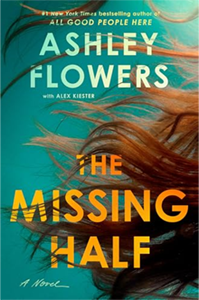 The Missing Half by Ashley Flowers with Alex Kiester
Nicole “Nic” Monroe is in a rut. At twenty-four, she lives alone in a dinky apartment in her hometown of Mishawaka, Indiana, she’s just gotten a DWI, and she works the same dead-end job she’s been working since high school, a job she only has because her boss is a family friend and feels sorry for her. Everyone has felt sorry for her for the last seven years—since the day her older sister, Kasey, vanished without a trace. On the night Kasey went missing, her car was found over a hundred miles from home. The driver’s door was open and her purse was untouched in the seat next to it. The only real clue in her disappearance was Jules Connor, another young woman from the same area who disappeared in the same way, two weeks earlier. But with so little for the police to go on, both cases eventually went cold. Nic wants nothing more than to move on from her sister’s disappearance and the state it’s left her in. But then one day, Jules’s sister, Jenna Connor, walks into Nic’s life and offers her something she hasn’t felt in a long time: hope.
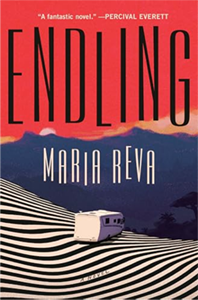 Endling by Maria Reva
Ukraine, 2022. Yeva is a loner and a maverick scientist who lives out of her mobile lab.She scours the country’s forests and valleys, trying and failing to breed rare snails, while her relatives urge her to settle down and finally start a family of her own. What they don’t know: Yeva already dates plenty of men—not for love, but to fund her work—entertaining Westerners who come to Ukraine on guided romance tours believing they’ll find docile brides untainted by feminism and modernity. Nastia and her sister, Solomiya, are also entangled in the booming marriage industry, posing as a hopeful bride and her translator while secretly searching for their missing mother, who vanished after years of fierce activism against the romance tours. Together they embark across hundreds of miles: three angry women, a truckful of kidnapped bachelors, and Lefty, a last-of-his-kind snail with one final shot at perpetuating his species.
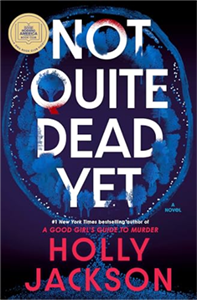 Not Quite Dead Yet by Holly Jackson
Jet is the daughter of one of the wealthiest families in Woodstock, Vermont. Twenty-seven years old and back home, she’s still waiting for her life to begin. I’ll do it later, she always says. She has time. Until Halloween night, when she is violently attacked by an unseen intruder, suffering a catastrophic head injury. Doctors are certain that within a week, the injury will trigger a fatal aneurysm. To her parents’ dismay, Jet rejects an extremely risky operation in order to guarantee herself at least a few more days. Jet never thought of herself as having enemies. But now, in the one week she has left, she looks at everyone in a new light: her family, her former best friend turned sister-in-law, her ex-boyfriend. As her condition deteriorates, she reconnects with her childhood friend Billy, the only one willing to help her. With Billy at her side, she’s absolutely determined to finally finish something: Jet is going to solve her own murder.
Summaries and images adapted from publishers.