
 We bring in the New Year with wild expectations for the future. Most of us resolve to change the things we do not like about ourselves. It is only natural to work toward self-improvement. Most resolutions start out with “I want to stop (fill in the blank)”. It could be smoking, eating sugar, nail biting, loafing on the couch or a variety of other bad habits. Unfortunately most resolutions are broken before February 1st. Why? One of the main reasons is because the goals are often too vague or too unrealistic. It takes a lot more than wishful thinking to make those lofty New Year’s resolutions stick. Ask yourself the following six questions to, once and for all, make the changes you want.
- Pick a goal that excites you
“The biggest mistake people make is picking the wrong goal in the first place,” says Talane Miedaner, author of Coach Yourself to Success. “Never set goals that are over a year old, because they’re ‘dead.’” Losing weight is a perfect example—some people carry that around for decades. “If you still want to slim down after years of trying, then do something different,” she says. “Sign up with a running group and train for a marathon, or take ballroom dancing lessons and enter a dance competition.”
- Create a master plan
Determine what you actually need to do to achieve your goals—that’s your master plan. Maybe you’ll have to wake up an hour earlier to write your best-selling novel, or spend one lunch hour a week volunteering with a nonprofit organization. To succeed, you have to schedule your goals and make them part of your life. Put a system in place that will support change by giving you the structure you need.
- Take baby steps
“When you break your goal down into smaller parts, it becomes more controllable, less daunting and more attainable,” says Christa Wagner, professional organizer and owner of Savvy Solutions. Lofty goals often feel overwhelming, which leads to procrastination and incompletion. Wagner uses her own life as an example: “I’m developing an eBook series from Savvy Solutions,” she says. “I have about 10 books I want to write. To reach my goal in six months, I’ve broken it down into daily and weekly tasks.”
- Call in the reinforcements
Get supportive folks in your camp and avoid the naysayers. Join a group of like-minded folks, team up with a good friend, hire a coach or otherwise include people who want the best for you and will keep you on track. If you know someone with a similar goal—or any goal at all—invite him/her to be an accountability buddy. Then, check in with each other regularly to make sure you’re on track. To get the support you need let others know how you’d feel most encouraged.
- Keep your eye on the ball
Keep your goals insight by putting reminders on your wall, at your desk and in your planner. This allows you to check-in often, make adjustments, and check goals off as they are attained. A great way to plan your future is with a vision board which uses maps, lists and pictures that embody success to keep you motivated. And, visualizing how you’ll feel after achieving your goal unleashes the power of your subconscious mind—which further propels you toward success.
- Reward yourself
To stay focused and motivated for the long haul, celebrate your successes. For example, reward yourself monthly with a pedicure and quarterly with a massage. It will keep you rejuvenated and energized. If you want to lose 20 pounds, for example, don’t wait until you’ve lost it all to celebrate. If you reward yourself with something that makes you feel beautiful each time you shed a few pounds, you’re more likely to achieve your end goal.
Lastly, stop making excuses. Hold yourself accountable and get out of your own way—because you’re the only person who can make a positive difference in your life!” Read more here!

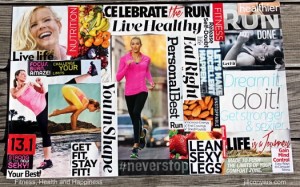
If you think vision boards are bogus, then the joke’s on you. They work, and there’s actually a really simple explanation of why they work so well.
Creating a sacred space that displays what you want actually does bring it to life. What we focus on expands. When you create a vision board and place it in a space where you see it often, you essentially end up doing short visualization exercises throughout the day.
Visualization is one of the most powerful mind exercises you can do. According to the popular book The Secret, “The law of attraction is forming your entire life experience and it is doing that through your thoughts. When you are visualizing, you are emitting a powerful frequency out into the Universe.”
Whether you believe that or not, we know that visualization works. Olympic athletes have been using it for decades to improve performance, and Psychology Today reported that the brain patterns activated when a weightlifter lifts heavy weights are also similarly activated when the lifter just imagined (visualized) lifting weights.
So, what’s the big secret to creating a vision board that works? It’s simple: Your vision board should focus on how you want to feel, not just on things that you want. Don’t get me wrong, it’s great to include the material stuff, too. However, the more your board focuses on how you want to feel, the more it will come to life.
There is only one major rule to creating a vision board that works, and it’s that there aren’t any rules. You aren’t going to mess it up, you can create your vision board on your own terms. Here are the answers to the most common questions people ask:
Q: What should I put on my vision board?
A: Anything that inspires and motivates you. The purpose of your vision board is to bring everything on it to life. First, think about what your goals are in the following areas: relationships, career and finances, home, travel, personal growth (including spirituality, social life, education) and health.
You don’t have to cover each area exactly the same, just take a mental inventory of what you want each of those areas to look like and write them down. Always handwrite your goals instead of typing them, there’s something energetic about actually handwriting your goals. From your goals and aspirations, think about what you want on your vision board. Like I said before, what you focus on expands. You’ll be amazed at how things just start popping up all over the place once you set the intention for what you want and how you want to feel.
Q: Should I have one main vision board, or a bunch of small ones for different areas of my life?
A: It’s totally up to you. What makes the most sense in your life? I personally like to have one central vision board that I look at every day in my home office, and I have a few small ones that I’ve made at retreats that I keep around too. Each area of our lives affect each other, so starting with one central vision board usually makes sense. Theme boards that center on specific events or areas of your life are great too, for instance a wedding-day-specific will help you focus on how you want to feel on your big day, or a career specific board at your desk space can help you work towards that promotion.
Q: How often should I re-do my vision board?
A: Whenever it feels right. I often leave blank space on my vision board so I can accept new things as they appear in my life, and add and rearrange during the year when I feel it. You’ll just know. Then, every December, I give the board a total refresh to get clear about what I want in the new year. Some things stay and some have served their purpose and don’t make the cut.
What you’ll need:
- Any kind of board, if you’re new maybe start with a cork board or poster board from the hardware store, they run about a dollar.
- Scissors, tape, pins, and/or a glue-stick to put your board together.
- If you want, fun markers, stickers, or anything else you can think of to deck out your board.
- Magazines that you can cut images and quotes from.
- Most importantly, the stuff you want to look at every day. Photos, quotes, sayings, images of places you want to go, reminders of events, places, or people, postcards from friends and just about anything that will inspire you.
- Time. Give yourself a stress-free hour or two to put your board together. If you’re a social butterfly, invite you friends over and make a party out of it.
How to do it:
- Set the mood. Turn off the TV and turn on some relaxing music. Light a candle and clear your space.
- When it comes to actually putting your stuff on the board, I like to leave space in between each item because clutter clouds my mind. I like space. However, if you love the feeling of closeness and want everything to touch and overlap, then huddle it all together and overlap your objects. As for choosing what makes the final cut, lay everything out before you start gluing and pinning so you can get an idea of where you want everything.
- Get more info about vision boards here!
January 2016 Challenge
Create a vision board using the techniques above to help you stay focused and attain your 2016 goals. Let me know if you completed the challenge by February 4, 2016 by emailing mtalicska@nmc.edu. If you want to send me a photo I will not share with anyone. Happy imaging.
The following recipes were provided by staffers as part of the November healthy eating challenge.
30-minute Veggie Ragu- Adapted from Iowa Girl Eats SERVES 5-6
Submitted by Amy Burns
Ingredients
- 2 Tablespoons extra virgin olive oil
- 1/2 onion, Finely chopped
- 3 cloves garlic
- 1 large carrot, peeled then Finely chopped
- 1 rib celery, Finely chopped
- 4oz sliced mushrooms
- ½ Green Pepper, Finely chopped
- Red pepper and pepper (to taste)
- 1/2lb ground beef or ground turkey or ground chicken (I used 85/15)
- 24oz high quality marinara sauce (I used Fricanos )
- 1/2 cup low sodium chicken broth
- 1/4 cup chopped fresh basil
- 1lb Veggie Spaghetti (I used Barilla)
Directions
- Add onions and garlic to the bowl of a food processor then pulse until minced, or mince by hand. Heat oil in a large skillet with high sides over medium heat then add onions and garlic and sauté until softened, 5 minutes.
- Meanwhile, add carrot, celery, peppers and mushrooms to the bowl of the food processor then pulse until minced, or mince vegetables by hand. Add to skillet then turn heat up to medium-high. Season with salt and pepper then saute until vegetables are tender, 5 minutes.
- Add ground beef to skillet, season with red peper and pepper, then saute until no longer pink, breaking it up as it cooks. Add marinara sauce and chicken broth then stir to combine, turn the heat down to medium, and then place a lid partially on top and simmer for 10 minutes, stirring occasionally. Stir in fresh basil.
- Meanwhile, bring a large pot of salted water to a boil then drop in spaghetti. Cook until al dente then serve tossed with ragu.
Sweet Potato Chili
Submitted by Karen Ruedinger
Ingredients
- 2 large sweet potatoes (cooked and peeled)
- 5 1/2 cups of beef broth (I used a 32 oz carton and it was perfect)
- 2 tbsp olive oil or butter
- 4 large carrots, chopped
- 1/3 cup unions, chopped
- 2 macintosh apples, peeled and chopped
- 1 lb sweet pork sausage (fried/cooked)
- 1 15 oz can garbanzo beans
Directions
- In a blender, combine broth and cooked sweet potato. Puree and set aside. In a large pot, cook the pork sausage and then set aside. Remove the grease but reuse the pot to saute the carrots and onion in butter or olive oil until tender. Add the pork sausage, puree, apple pieces and garbanzo beans. Cook until hot and enjoy!
Weight Watchers – Turkey Shepard Pie
Submitted by Dott Witt
Serving Size 6
Ingredients
- 1 large uncooked sweet potato, peeled and cut into 2inch pieces
- 1/3 cup low-fat milk
- 1/4 tsp garlic powder
- 1/8 tsp table salt, or to taste
- 1/8 tsp black pepper, freshly ground, or to taste
- 2 tsp olive oil
- 1/2 cup sliced uncooked red onion, chopped
- 2 medium garlic cloves, minced
- 6 medium uncooked baby carrots, chopped
- 20 oz uncooked turkey sausage (remove casing)
- 1 tsp dried oregano
- 1 tsp dried thyme
- 1/4 tsp black pepper, freshly ground
- 10 3/4 fl oz canned tomato soup, made with low-fat milk
Instructions
- Preheat oven to 400ºF.
- Place potatoes in a medium saucepan and pour in enough water to cover potatoes. Set pan over high heat and bring to a boil; boil until fork-tender, about 8 minutes. Drain potatoes; return potatoes to pan.
- Mash potatoes with milk and garlic powder until smooth; season to taste with salt and pepper.
- Meanwhile, heat oil in a large skillet over medium heat. Add onion and garlic; sauté until tender, about 3 minutes. Add carrots; sauté 1 minute. Remove vegetables from skillet; set aside.
- Add turkey sausage to skillet; sauté until browned, breaking up sausage as it cooks with a wooden spoon, about 5 minutes. Return vegetables to skillet; stir to combine. Add oregano, thyme and 1/4 teaspoon of black pepper; cook 1 minute.
- Add tomato soup; simmer until liquid is absorbed and mixture is thick, about 2 minutes.
- Remove skillet from heat and spoon mixture into a 9-inch pie plate.
- Spoon mashed potatoes over turkey mixture and spread into an even layer using the back of a wooden spoon.
- Bake until filling is bubbly, about 25 minutes. Slice into 6 pieces and serve.
Yields 1 piece per serving.